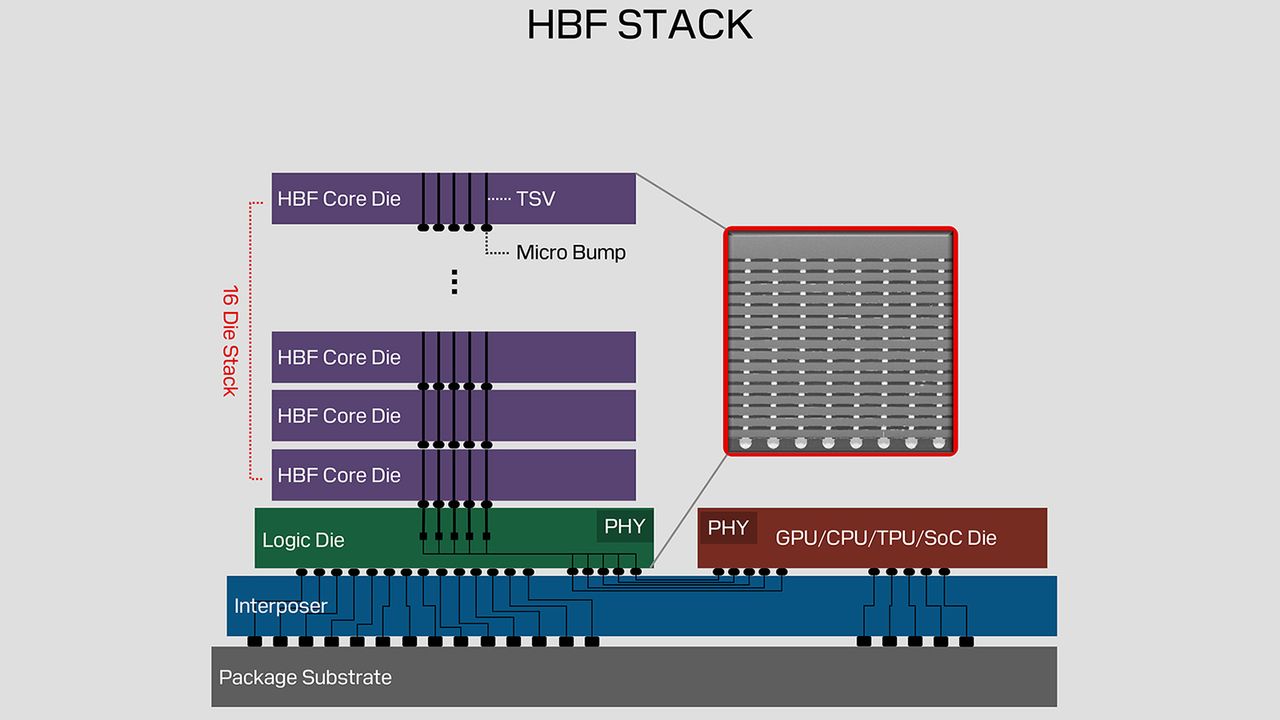
A new frontier in GPU memory expansion has been unveiled by storage giants SanDisk and SK Hynix with the formal introduction of the Hybrid Bonding Interface (HBF) specification. This innovative technology is set to revolutionize how graphics processing units (GPUs) access and utilize memory, potentially offering terabytes of additional capacity and significantly boosting performance.
The HBF specification outlines a sophisticated architecture that can achieve an impressive bandwidth of up to 3 TB/s, a critical factor for high-performance computing, artificial intelligence, and graphics-intensive applications. This immense throughput is made possible through the integration of 16-Hi NAND stacks, allowing for a substantial increase in memory density and parallelism.
Affiliate contentGames up to -90% off
Instant key delivery on Instant Gaming
Browse deals →Furthermore, the HBF standard incorporates the Universal Chiplet Interconnect Express (UCIe) specification, ensuring broad compatibility and facilitating modular chip design. By enabling a seamless interface between GPUs and vast pools of NAND memory, HBF promises to overcome current memory bottlenecks that often limit the performance of modern accelerators.
While the potential benefits are immense, the adoption of this cutting-edge technology is still in its nascent stages. Currently, only four companies have expressed interest in integrating HBF into their product roadmaps, indicating that widespread implementation may take some time. Nevertheless, the HBF specification represents a significant step forward in hardware design, paving the way for GPUs with unparalleled memory capabilities and reshaping the landscape of high-performance computing.